Most people still ask a binary question: is a VPN banned here, or not? That framing is already out of date. Across 2025 and 2026 the pressure on encrypted tunnels has spread into several layers at once — outright blocks in authoritarian states, compliance and registration rules in others, and a newer push in democracies that leaves the app legal while treating it as a way to dodge age checks.
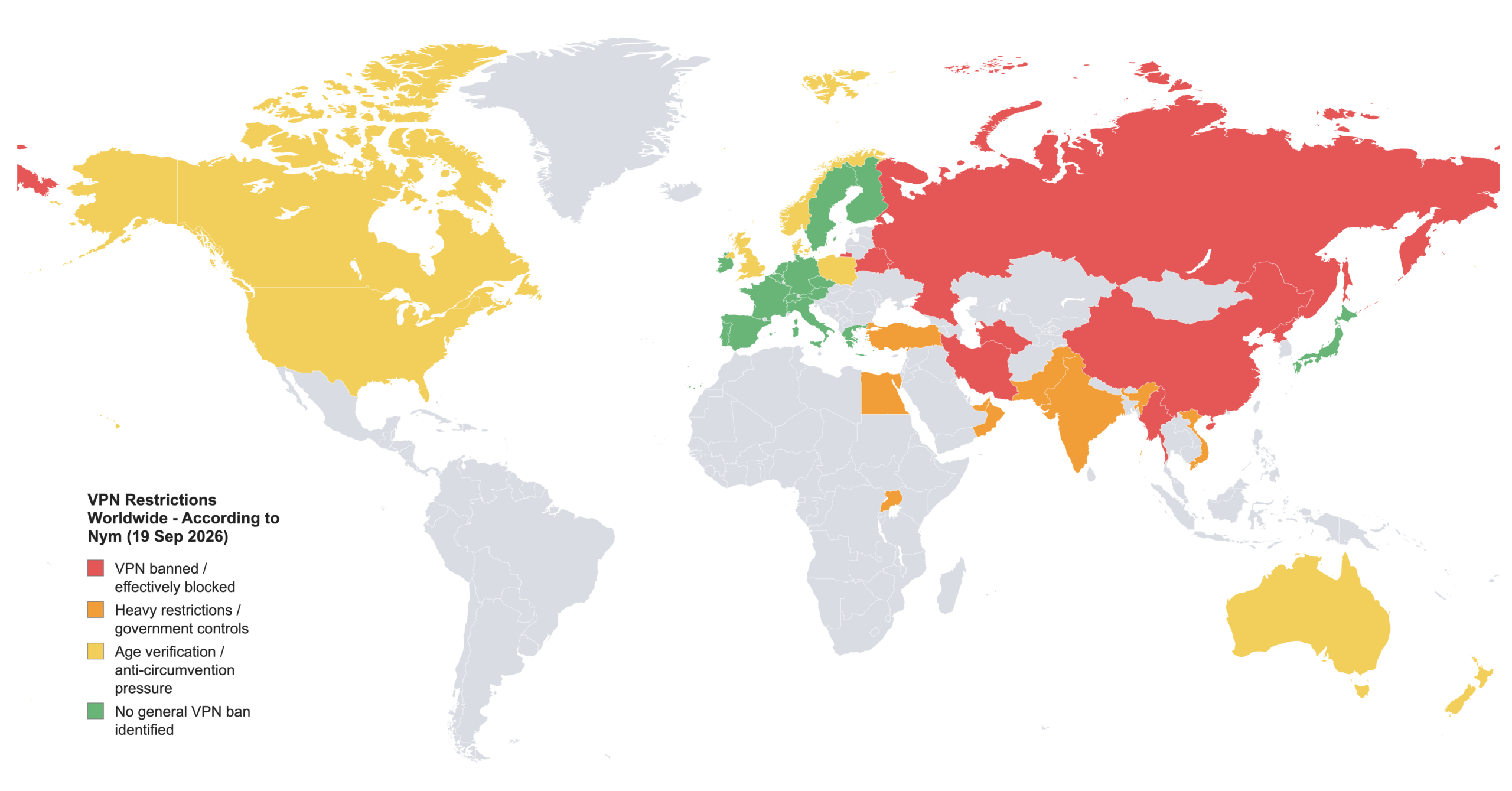
A September 2026 overview from NymVPN’s account mapped that spectrum country by country. The useful part is not a colour-coded scoreboard. It is the sequence the map implies. Governments rarely jump straight to a blanket ban when softer tools will do. Blocking, licensing, data-retention mandates, age-verification rules, and VPN detection all shrink the same space from different angles.
Where VPNs are banned or effectively blocked
At the hard end of the spectrum, unauthorized VPN use is unavailable or heavily suppressed. North Korea sits at the extreme: meaningful consumer VPN access is effectively off the table. Turkmenistan, Iran, China, and Myanmar keep unauthorized services under heavy blocking or legal restriction. Belarus has tightened controls. Russia has blocked large numbers of commercial providers while leaving a narrower, more monitored path for what still works.
These are not “privacy preference” markets. They are environments where the network itself is an instrument of control. A tunnel that restores blocked news, messaging, or foreign services is treated as a political problem, not a product category. Users who need a path out often face deep packet inspection, IP blacklists, app-store removals, and criminal or administrative risk if they get it wrong. Marketing that pretends every country is equally open is doing those readers a disservice.
Heavy restrictions without a clean ban
A second tier looks softer on paper and harder in practice. India has pushed major compliance and data-retention requirements onto VPN providers. Jammu and Kashmir has seen temporary local bans. Türkiye blocks many services. The UAE treats legitimate VPN use as legal while attaching penalties to misuse. Oman, Egypt, Uganda, Vietnam, and Pakistan have layered regulatory pressure, registration attempts, or traffic restrictions that make reliable access uneven even when a blanket prohibition is not on the statute books.
This is the registration-and-logging model. The product stays available to people who accept a more surveilled version of it, or to providers willing to keep records the state can request. Providers that refuse those terms get blocked or leave. The user experience becomes a lottery of which apps still connect this month, and whether “working” still means private.
Age checks and anti-circumvention pressure
The newest pressure band is mostly in countries that still say they have no general VPN ban. The United Kingdom, Australia, parts of the EU, several U.S. states, New Zealand, Norway, Denmark, Poland, and Canada have all seen age-verification rules or proposals that treat VPN use as a way around those checks. Utah’s law targeting VPN circumvention of age gates is one clear example; enforcement there has already collided with litigation, which tells you how contested the idea is.
That fight matters because it redefines the product. A VPN does not mint a fake age credential. It changes the country signal a website sees. When regulators answer that with detection, jurisdiction-over-the-person rules, or talk of age-gating the tunnel itself, the app can remain legal while becoming less useful for anyone who wanted a private path without uploading an ID. We covered that chessboard in more detail when the EU and UK debate heated up earlier in 2026.
Where there is still no general ban
Plenty of places still have no nationwide VPN prohibition: Germany, France, Japan, Switzerland, the Netherlands, Sweden, Finland, Spain, Italy, Ireland, Belgium, Austria, Czechia, Portugal, Greece, and the federal level in the United States and Canada, among others. That list is not a permanent guarantee. It is a reminder that legality and friction are different variables. A country can leave the software lawful and still expand the infrastructure that notices, flags, or regulates how it is used.
The real trend is layered control
Read across the map and a pattern shows up:
- outright bans in the most closed networks
- technical blocking and DPI where bans are awkward to enforce cleanly
- provider regulation and mandatory registration where the state wants logs
- age-verification rules that cast tunnels as a circumvention tool
- detection systems that leave the app legal while taxing the useful part of it
The VPN itself is not always what gets banned. Sometimes the goal is to make using one unreliable, logged, or socially risky until most people stop bothering. That is a quieter outcome than a headline ban, and it is easier to sell as child safety, national security, or “legitimate use only.”
What this means if you still want a private path
Know which layer you are actually dealing with. In a blocked market, the question is whether any trustworthy provider can still connect, and what the local legal risk is. In a compliance market, the question is whether your provider will keep the logs the state wants. In an age-check market, the question is whether platforms will detect the tunnel and demand identity anyway. One product name covers all three situations. The failure modes do not.
Choose a provider for the threat you actually face. Prefer modern protocols, a clear no-logs practice, and a company that would rather leave a market than quietly become a logging intermediary. Keep the client updated. Expect blocks and detection to move faster than marketing pages. And remember the limit that never changes: a relocated IP does not relocate your body. Local law still applies to the person holding the phone.
Maps like Nym’s are useful because they refuse the fake binary. The internet is not splitting into “VPN legal” and “VPN illegal.” It is splitting into places where encrypted tunnels are fought as dissent, places where they are regulated into compliance, and places where they are left legal while being treated as a loophole in the next identity gate. If you care about private access, watch that sequence — not only the red countries on the chart.