
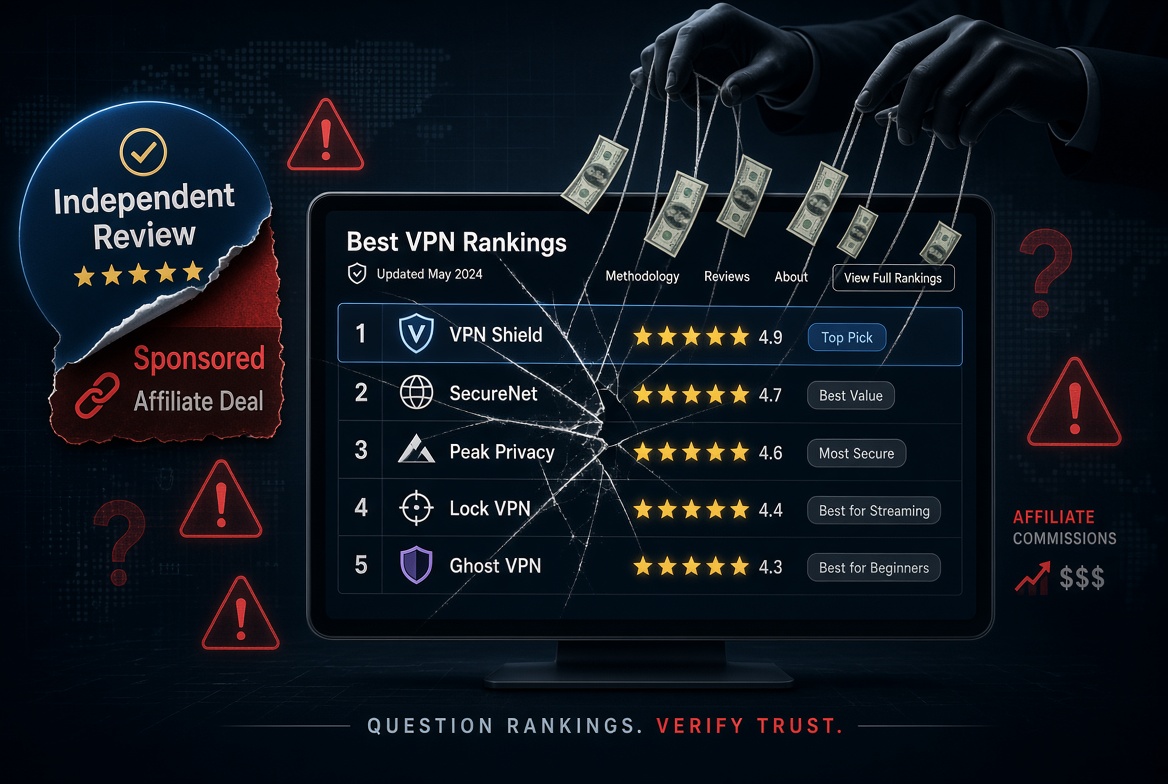
If you’ve ever searched “best VPN” or “VPN comparison,” you’ve seen the same handful of services dominating the top spots across dozens of sites. ExpressVPN, NordVPN, CyberGhost, Surfshark, and a few others appear again and again as the “winners.” It looks like consensus. In reality, much of that consensus is manufactured.
Many popular VPN review and comparison sites are not independent arbiters of quality. They are either owned by (or tightly linked to) the same companies that sell the VPNs they rank, or they operate primarily as affiliate marketing vehicles. The result is a landscape where rankings frequently reflect commercial relationships more than rigorous, unbiased testing.
Ownership Conflicts of Interest
Several high-traffic review sites share corporate ownership with major VPN brands.
Kape Technologies owns ExpressVPN, CyberGhost, Private Internet Access (PIA), and ZenMate. Through its subsidiary Webselenese, Kape also owns or controls popular review sites including vpnMentor, Wizcase, and related properties. After Kape acquired these review platforms, rankings on those sites shifted in ways that favored Kape-owned products. This is the textbook definition of a conflict of interest: the company selling the product also controls some of the loudest “independent” voices recommending it.
Ziff Davis (the parent of PCMag, CNET, Mashable, and other tech media brands) owns VPN services including IPVanish and StrongVPN. When those media outlets publish VPN roundups, readers are consuming content from a company with a direct financial stake in certain VPN products.
Other examples of consolidation and cross-ownership exist in the industry. What looks like a diverse marketplace of competing review sites is, in practice, a smaller number of parent companies controlling both products and the information about those products.
Would you trust a restaurant review written by the restaurant’s parent company? Most people would not. The same logic applies here, even when the ownership is disclosed in fine print that few readers notice.
Affiliate Marketing as the Business Model
Even sites without direct ownership ties usually earn money through affiliate commissions. When a reader clicks a link and signs up for a VPN, the review site receives a cut—sometimes a large one. Commissions can run tens of dollars per sale (and higher for longer plans or certain providers). High-paying affiliates tend to appear more frequently in “top 5” or “best of” lists.
This creates a structural incentive: recommend the VPNs that pay the most, not necessarily the ones that perform best on privacy, transparency, speed, or jurisdiction. Some sites rank services that have faced serious past issues (security incidents, weak practices, or ownership concerns) highly while downplaying or ignoring lower-commission alternatives that score better on independent criteria.
Affiliate relationships are often disclosed somewhere on the site, but the disclosure is frequently buried. The ranking lists and glowing prose remain front and center. For many readers, the commercial relationship is invisible.
Why the Rankings Look So Similar
Because a relatively small number of large VPN brands invest heavily in affiliate programs and, in some cases, own review platforms, the same names rise to the top across many sites. This creates an illusion of broad agreement. In reality, the agreement often reflects shared commercial incentives rather than independent verification.
Academic and investigative work has noted that recommendation sites in this space are frequently money-motivated, with paid placements and rankings influenced by commercial ties.
What This Means for Users
VPN choice is not trivial. People use these services for privacy, security, accessing restricted content, or protecting themselves in high-risk environments. Relying on compromised recommendations can lead users toward services with weaker no-logs practices, problematic jurisdictions, opaque ownership, or histories of incidents that were not fully disclosed at the time.
The industry’s heavy consolidation and the review-site conflicts make it harder for genuinely independent or smaller providers (those that refuse high-commission affiliate programs or prioritize transparency over marketing spend) to get fair visibility.
How to Approach VPN Research More Skeptically
- Check ownership. Look up who owns the review site and who owns the VPN brands it promotes. Public filings, company about pages, and investigative reporting often reveal the connections.
- Treat affiliate-heavy “best of” lists as marketing, not journalism. Prefer sites that publish detailed, reproducible testing methodologies and that do not rank solely by commission potential.
- Look for independent technical testing (leak tests, audited no-logs claims, jurisdiction analysis) rather than marketing copy.
- Consider sources that explicitly reject or limit affiliate influence, or that focus on privacy-focused criteria rather than feature checklists and speed tests alone.
- Cross-check claims against multiple independent sources and primary evidence (audit reports, court cases, company disclosures) instead of relying on any single ranking page.
Not every review site is equally compromised, and some individual writers or smaller outlets try to maintain higher standards. But the dominant pattern in the “best VPN” search results is commercial rather than editorial.
The next time a site tells you which VPN is “clearly the best,” ask yourself who benefits from that ranking. In too many cases, the answer is the same company (or corporate family) that stands to profit from the recommendation. Independent evaluation still exists, but you usually have to look past the loudest and most heavily optimized comparison pages to find it.